Fourball Better Ball is one of the most popular formats in the competition calendar, and it is also one of the most common sources of questions we receive about how handicap scores are calculated. With the Easter Tankards behind us and the Mixed Fourball for the Edward’s Cup coming up in May, now is a good time to set the record straight.
The format itself is straightforward enough: you and your partner each play your own ball, and the better net score between you counts for the team on each hole. Where things become less intuitive is understanding when your individual round qualifies as a handicap score. The answer involves three specific conditions, and all three must be met. This is not a case of ticking one or two boxes; every condition is required.
The Three Conditions
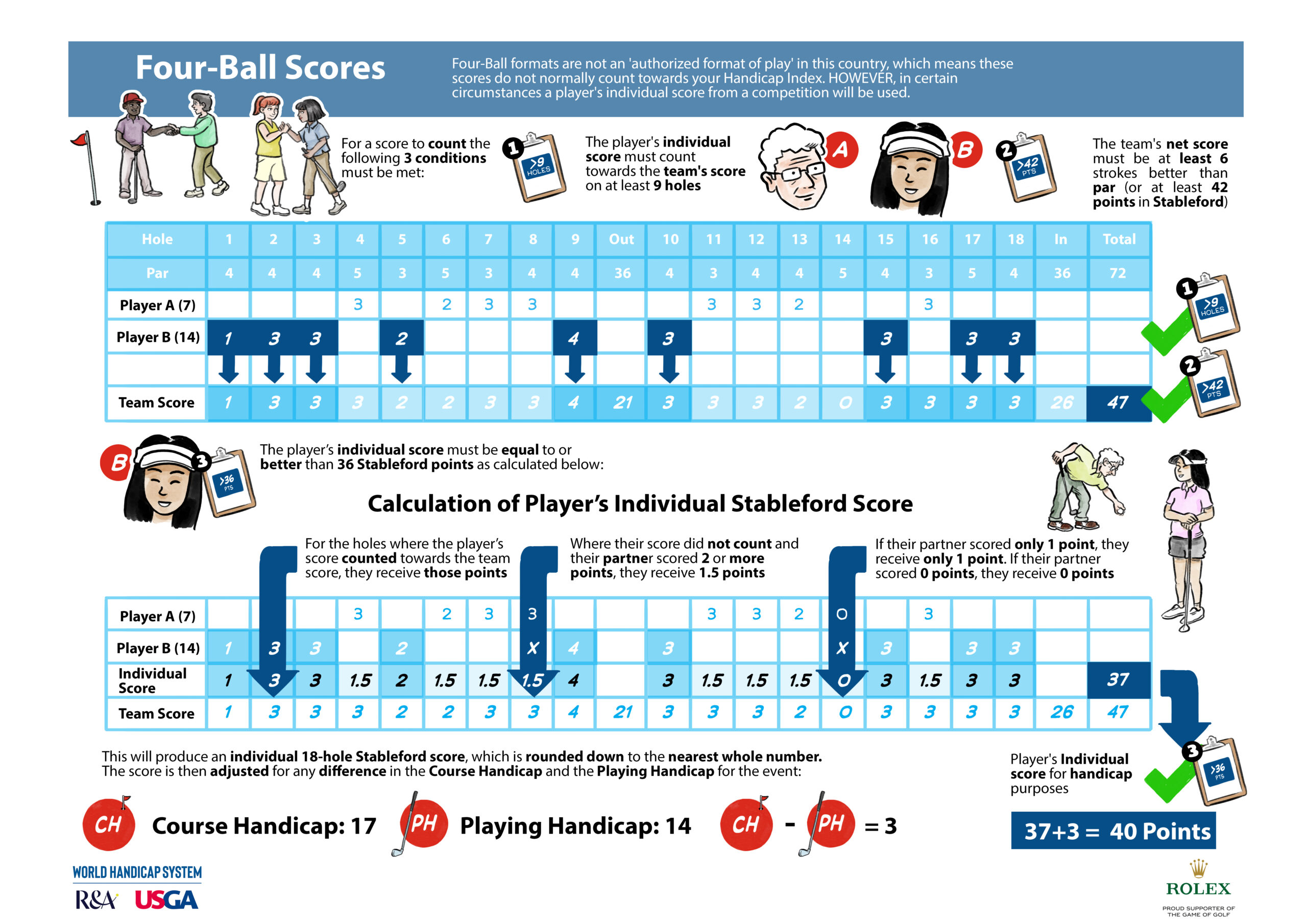
Condition 1: You must have contributed to the team score on at least 9 holes. Your individual score must have counted towards the team total on a minimum of nine holes throughout the round. If your ball was not in play, or your score did not beat your partner’s on enough holes, this condition may not be satisfied regardless of how well you played overall.
Condition 2: The team’s combined net score must reach the qualifying threshold. The team’s net score must be at least 6 strokes better than par. In Stableford terms, this means a combined team total of at least 42 points. If the team does not reach this threshold, neither player’s score qualifies for handicap purposes, regardless of individual performance.
Condition 3: Your individual Stableford total must reach at least 36 points. This is where the calculation requires a little more explanation. Your individual 18-hole total is not simply your raw score. It is calculated hole by hole, as follows:
- If your score counted for the team, you receive those Stableford points in full
- If your score did not count and your partner scored 2 or more points, you are credited with 1.5 points
- If your score did not count and your partner scored 1 point, you receive 1 point
- If the team scored zero on the hole, you receive zero
Your total across all 18 holes is then rounded down to the nearest whole number. Any difference between your Course Handicap and your Playing Handicap for the event is applied as a final adjustment before submission.
Only when all three conditions are satisfied will your score be submitted to England Golf and count towards your World Handicap Index.
A Common Misconception Worth Addressing
We occasionally see members carefully noting down every score across all 18 holes, which is understandable given that a full scorecard feels like a complete round. However, if your score did not count towards the team on a given hole, it does not contribute to your individual handicap calculation, regardless of what you wrote on the card. The conditions above determine eligibility, not the act of recording a score.
This is also the reason we ask members to pick up when their partner’s ball is already in a strong position on the hole. If your net score cannot beat your partner’s, your ball is out of the team equation for that hole. Carrying on to hole out when the result is already decided adds time without adding value, for the team, for the scorecard, or for your handicap submission.
A Note on Pace of Play
In a field of any size, Fourball Better Ball has the potential to be one of the slower formats on the course. Each partnership playing two balls per hole, multiplied across a full field, adds up quickly. The single most effective thing every pairing can do is pick up promptly when the hole is decided and record only the one score that counts for the team. It keeps the card clean, reduces errors at the submission stage, and most importantly keeps the round moving for everyone on the course. We appreciate every member’s support in this regard.
If you have any questions, feel free to reach out to our Competitions Manager, Mark Nicholas.