Dear Member,
We are in the process of completing our spring course maintenance on the greens, tees, approaches and fairways but there’s been a move away from hollow coring on greens this year and here’s why. Instead of the removal of organic material via hollow coring, we’ve elected to deep sand fill scarify instead. So, as a replacement for holes backfilled with sand, you’ll see sand filled lines. We last used this technique here in 2019 so this isn’t new to us but for reasons that will follow is the better option under certain circumstances.
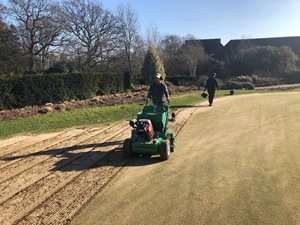
What’s the difference I hear you cry? The machine uses blades as opposed to tines that cut a 2mm wide grove, 20mm deep, at a spacing of 30mm and both removes the soft, wet organic matter and replaces it with clean fresh sand (see photo of it in action on the pro-shop putting green). The net effect is increased surface firmness because of this two-stage process. Cast your minds back to your last beach visit, the sand closest to the water was firm and easy to walk on due to no organic matter and good moisture levels. That principle is used to firm up golf greens!
Why is firmness important? We want the ball – when impacting the surface – to react in a certain way: impact, check, release and not just impact and plug. The firmer the greens are, the longer the effects of rolling last and so too their pace or speed. Player traffic in the form of foot printing will be felt less so putts roll smoother and truer for longer. Finally, greens that are shaded will often be firmer than those in full sun because growth is poorer here, and so the consistency may become an issue between greens but not so with this process. Firm is the new fast, you heard it here first!
The first 20mm depth of the greens is the most dynamic in growth terms and organic matter can accumulate faster nearer the surface than deeper in the soil profile. Hollow coring uniformly removes organic matter from the surface to 100mm deep but if it’s accumulating faster within the 0-20mm range, it does nothing to specifically target this layer. That’s where the sand fill scarifying comes in, working intensively at the 20mm depth layer, pulling out what we don’t want and replacing it with what we do want in the area that matters. We had a wet summer in 2021 so higher plant growth rates than usual – at the surface level – producing the need to treat the greens differently this year to address the imbalance.
Laboratory analysis is used to objectively measure the exact content of organic matter within the greens, at 20mm depth increments, so we can make informed decisions on where best to target removal and how. This is important because it enables us to get the best performance return for our efforts ahead of the new playing season. If hollow coring was employed, we’d be missing the greater need of removal near to the surface and thus the greens would be softer than we’d want them to be. Does this mean we’ll never hollow core greens again? No, it doesn’t. There are other benefits of hollow coring such as the promotion of drainage/infiltration through the upper soil profile, soil decompaction and the promotion of deep plant rooting. So, depending upon the soil testing results and what we need to achieve, scarification and/or hollow coring will be used as necessary.
The recovery time is approximately the same between the two methods and of course very much depends upon the soil temperature’s influence upon growth. At this time of year recovery is slower than later in spring but if the works are conducted now, we will be in good shape for spring.
Thank you very much for bearing with us while we recover from the spring maintenance work, and I hope this information helps you to understand why we’ve changed tack this year.
John Lockyer
Director of Greens