The Challenge
Recent record-breaking rainfall has highlighted drainage challenges on the Church and Mill fairways, prompting questions from members about their performance compared to the newly renovated Garden fairways. These concerns focus on whether Church and Mill can achieve the same level of performance and if doing so would require a costly and disruptive renovation.
On a positive note, the weather in September and the first half of October have left no doubt in everyone’s minds that the design and installation quality of the new drainage system was completely successful. The Garden fairways have performed exceptionally well showcasing improved surface firmness and playability. This outcome proves that carefully designed and executed drainage solutions can significantly enhance course resilience and member experience.
The challenge now lies in determining how best to improve Church and Mill without replicating the scale or cost of the Garden project unnecessarily.
The Investigation
Historical Context
- Church and Mill fairways were renovated in 2011 and 2013, respectively, with primary and secondary drainage systems. However, these installations lacked the enhanced design features of the Garden system.
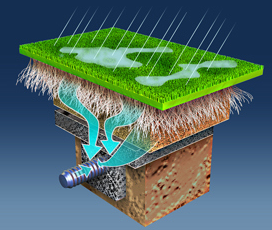
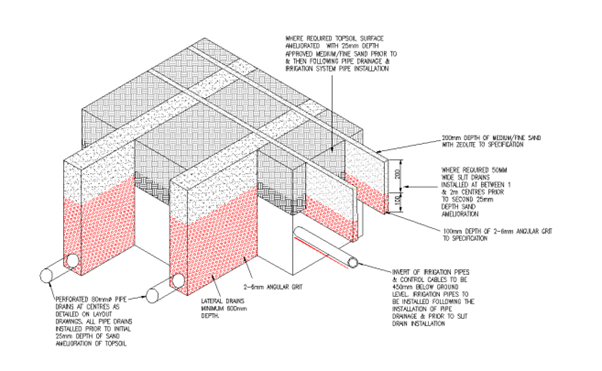
- The Garden system incorporated deeper carrier drainage, narrower spacing, and soil amendments, ensuring optimal performance and long-term durability even under climate stress.
Assessment and Testing
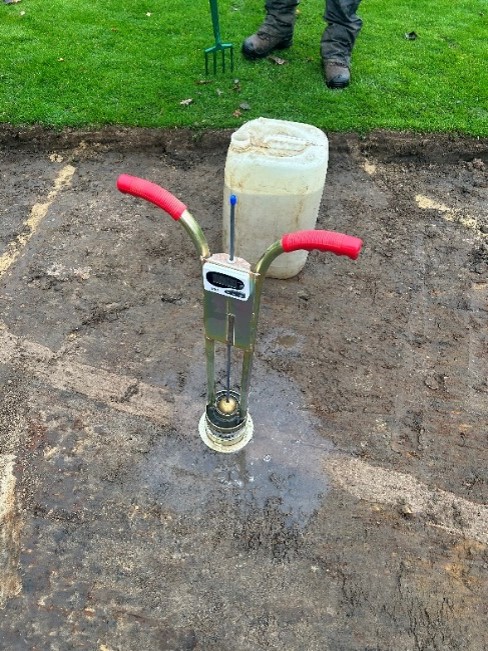
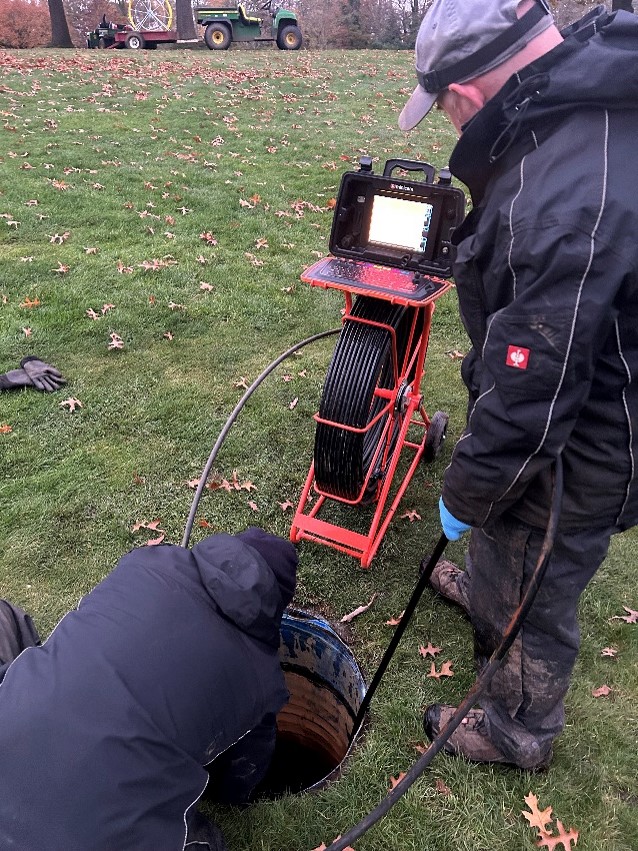
- Extensive investigations were conducted, including infiltration tests, physical inspections, and CCTV analysis of the drainage pipes.
Findings
- Pipes and slit drains on Church and Mill are functioning as expected for their age, moving water efficiently.
- Surface-level restrictions caused by organic matter and thatch build up are the primary cause of reduced drainage performance.
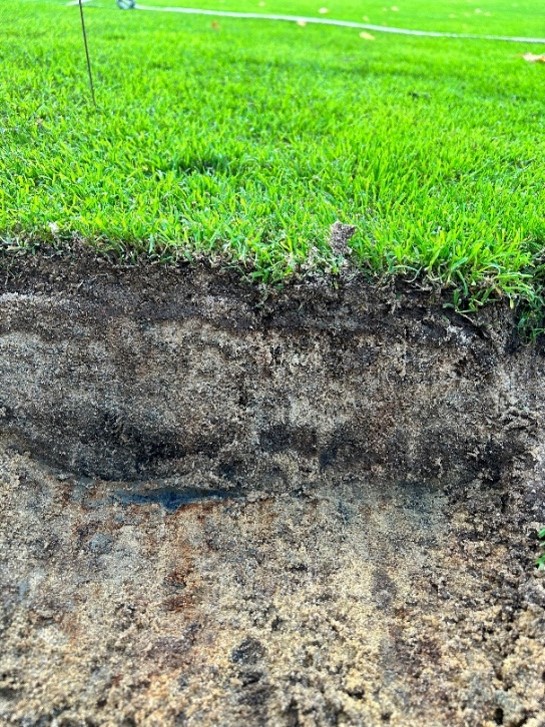
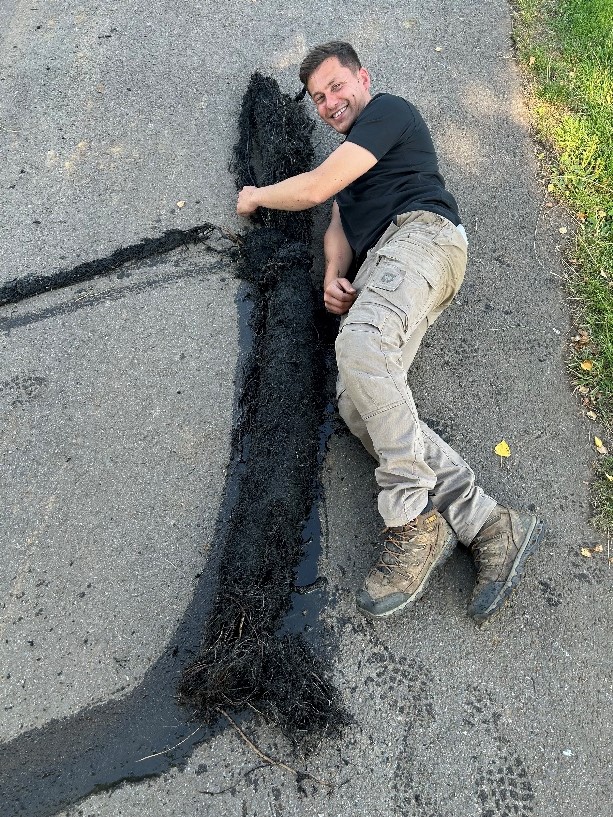
- Some minor blockages, including root intrusions, were identified but do not indicate imminent system failure.
- Note: we also found the occasional monster “rootberg” or a gathering of tree roots blocking pipes (pictured with Rob our irrigation tech to give scale)!
Surface-Level Restrictions
- Maintenance techniques like aeration and topdressing have delayed performance issues but can no longer address the problem alone.
- Water is being trapped in the thatch layer, starving the system of efficient flow despite its functional infrastructure.
The Solution
Short-Term Plan (2025)
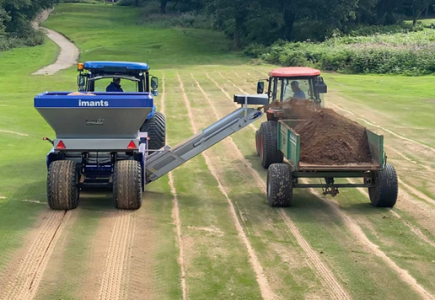
- Implement the “heavy maintenance, sand slit” approach to reconnect the surface to the existing drainage infrastructure:

- Install sand slits on Church and Mill fairways during scheduled summer maintenance weeks.
- Minimal disruption, with a quick recovery (4–6 week grow-in period).
Expected Outcomes
- Improved drainage, firmer fairways, and enhanced winter playability.
- Extends the lifespan of the current system without immediate need for costly replacements (costs included in the 2025 sustaining capital budget).
Mid-Term Strategy (2026 and Beyond)
- Introduce sand slits to Garden in 2026 to protect its high standard of performance.
- Continue with sand slitting on Church and Mill every 3–4 years to maintain improvements.
- Enhance all fairways with regular aeration and topdressing to dilute thatch and improve soil conditions.
Long-Term Consideration
- Monitor Church and Mill drainage systems annually, addressing minor issues as they arise (e.g., localized pipe replacements).
- Plan for a full system replacement only when the infrastructure becomes ineffective, which is not expected in the immediate future.
Positive Outlook
The success of the Garden project serves as a blueprint for future improvements, demonstrating how targeted investments can transform course performance. By applying similar principles through a less invasive approach, we aim to elevate Church and Mill to a comparable standard while preserving resources and avoiding months of disruption. This phased strategy ensures members benefit from improved conditions with minimal disruption and prudent financial management.
John Lockyer
Director of Greens